Google hasn't gone, but how customers find you is changing
You don't need to understand AI to feel its effects. The way people search for businesses like yours is shifting, and that shift has real implications for whether you get found online.
Understanding what's changing — even at a high level — will help you make smarter decisions about your website, your content, and your online presence.
What the Data Actually Shows
Before we get into what’s changing, here’s a quick reality check.
Google still dominates search in New Zealand, accounting for close to 90% of the market. And while AI-powered search is attracting a lot of attention, it still represents less than 2% of global search traffic. (SociallyIn, 2026)
That doesn’t mean AI isn’t important. It is. But it does suggest that, for now at least, the headlines are running ahead of actual behaviour. When it comes to finding local businesses, Google remains the go-to tool.
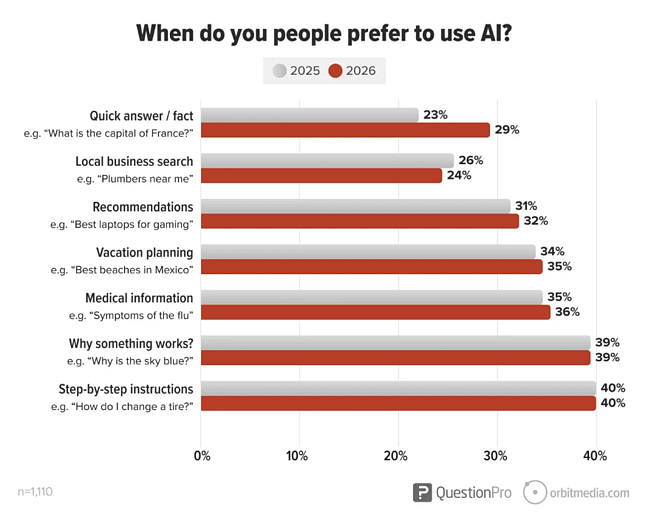
In fact, only 24% of people say they prefer using AI chat when looking for a local business. (Orbit Media, 2026)
There’s another point worth understanding. Even when people use AI to research options, they rarely stop there. Research from Bain & Company shows that AI is often used to build a shortlist, before people turn to Google, reviews, or business websites to confirm their decision.
Bain also found that trust in AI is higher for lower-stakes decisions, which helps explain why local service businesses remain more Google-dependent for now. (Bain & Company, 2026)
So this shows how search behaviour is evolving, but not overnight. And what matters most hasn’t changed — people are still looking for enough confidence to take the next step.
So What Has Actually Changed?
The honest answer: how people move between tools.
People aren’t choosing between Google and AI randomly. They’re guided by habit, intent, and which tool they trust for the type of question they’re asking. And those habits are still forming.
For now, Google remains the preferred tool when people are closer to taking action. Checking reviews, comparing options, and making a decision. If someone is ready to book a service, that’s still where they’re most likely to land.
But the lines are blurring. AI tools are increasingly being used for the kinds of queries that used to belong entirely to Google — “who's good for X near me,” “what's the best option for Y in my area.” These are the kinds of questions people ask as they move closer to making a choice, so the gap between tools is narrowing.
There’s one important caveat worth noting: around 58% of Google searches now end without a click on any website (referred to as zero-click searches). Google is answering questions directly on the results page through AI Overview summaries. So visibility and traffic aren't quite the same thing anymore. But, for context, being named in an AI answer, even without a click, still puts you in someone's consideration. (WebFX 2026)
AI Has Created an Entirely New Discovery Channel
People don't search the way they used to.
Instead of typing 'mechanic Whangārei' and scanning a list, they're asking 'where should I take my car for a service in Whangārei; somewhere reliable, honest, and with good reviews?' They're having a conversation. And the businesses that show up in that answer aren’t there because they bought an ad or ranked number one.
They’re there because their online presence gave AI enough confidence to recommend them.
The bigger picture is that Google and AI tools are converging on the same goal: deliver the best answer, not just the most links. Google's AI Overviews, local map pack, and AI Mode are all moving in the same direction as ChatGPT and Perplexity — away from rewarding whoever optimised hardest, toward trusting whoever built the most credible, consistent online presence.
Getting found used to mean ranking. Now it means being trusted by the people searching, and by the systems forming answers on their behalf.
That means you can't game your way in. But you can earn your place through well-written content that answers real questions, a strong review profile, and a consistent online presence across platforms.
📌 Important note: Different AI tools pull from different places; some from Google's indexed pages, some from near-real-time sources, and others from established entity data. Your visibility isn't determined by one thing. It's the sum of everything you've built online.
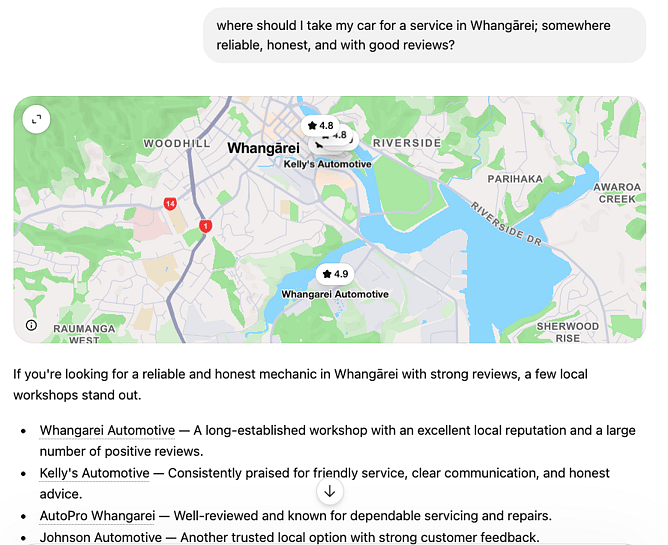
Photo: ChatGPT Screenshot of search query and the first section of the analysis given
The Bit That Actually Ties It All Together
Google has spent years building what's known as a Knowledge Graph. A global database of entities: businesses, people, places, and organisations, built from verified, consistent information across the web. Your Google Business Profile, your website, your reviews, and the consistency with which your business information appears across platforms all feed into it.
Entity data extends beyond Google. Your social media profiles, reviews, directory listings, forum mentions, and other online references all help shape how AI tools understand your business and assess its credibility.
That's why no single platform should be doing all the heavy lifting. Your website, your Google Business Profile, your reviews, online forums, Substack, your social media — each one contributes to the big picture. Together, they give every AI tool (including Google's own Gemini) something substantial to work with.
Does SEO Still Matter for AI?
Yes, and this is the reassuring part.
AI systems don't generate answers from thin air. Whether it's Google's AI Overviews, ChatGPT, or Perplexity, they draw (to varying degrees) on existing web content, reviews, directories, and other online sources. The same investment that makes you visible in Google — good SEO, a credible website, genuinely relevant content — is the same investment that makes you visible to AI.
The two aren't competing strategies; they're the same strategy.
The clearest proof? Google's own AI Overviews.
AI Overviews now appear in search results for around 25% of queries, up from 13% in March 2025. This isn't a separate AI tool competing with Google. This is Google — and the content it pulls from is well-structured, authoritative, regularly updated pages. Exactly what good SEO has always prioritised. (Superlines, 2026)
Getting cited in an AI Overview is quickly becoming one of the most valuable visibility goals in search, and the path there is the same one it's always been.
💡Pro Tip: Keep this in perspective — If you’re a small service-based business, remember that you’re not competing on a global stage. You're competing with the business down the road. The bar isn’t necessarily “outrank a New Zealand heavyweight.” It’s “show up more credibly than your local competitor when the right person goes looking.”
A consistent, well-maintained online presence is still the way to achieve that.
📌 Worth knowing: Pages updated within two months earn significantly more AI citations than pages older than two years. Keeping your site fresh isn't just good housekeeping; it's how you stay visible in both Google and AI search. (Superlines, 2026)

Do You Need to Write Differently?
Not as differently as you might think.
AI language models are trained on natural, human language. They prioritise content that genuinely answers questions, written the way real people talk and think. If you've been writing for your customers (addressing their real questions, speaking their language, solving actual problems), you're already more AI-ready than most.
The businesses that will struggle are the ones that wrote for algorithms instead of people. Keyword-stuffed pages, vague service descriptions that say a lot without saying anything, thin content that fills space without answering anything. None of that serves AI any better than it serves humans.
Write for your client. Answer the question they're actually asking. Get to the point quickly. That content ticks the boxes for both SEO and AI discoverability without needing to be two different things.
What Formatting Actually Helps
There is one area where structure makes a genuine difference, and it's worth being intentional about. AI systems increasingly pull excerpts rather than entire pages. Your content needs to be easy to segment.
Practically, that looks like this:
Use headings that answer questions, not just label sections. Use headings that answer questions, not just label sections. For example, “How does a marketing strategy actually work?” is more useful than simply “Our Process”.
Write self-contained sections. Each part of your page should make sense on its own, without requiring the reader to have read everything before it.
Include FAQ-style content. Pages with FAQ sections averaged higher citation rates than those without. (Superlines) If you're regularly asked the same questions by clients, those belong on your website.
Answer first, then explain. Don't bury the answer three paragraphs in. Lead with it, then provide the context. That's what both Google and AI want to surface (and likely what your online visitors prefer).
If your website is already doing the basics well, this is mostly about being more deliberate with structure as you create new content going forward. If you're not sure where your site actually stands — that's worth finding out.
Does Your Google Business Profile Still Matter?
Yes, and this is where local businesses have a real advantage.
Local search (someone looking for a service in their town) still runs overwhelmingly through Google. And your Google Business Profile directly affects whether you show up in local search results, what information people see when they find you, and whether they choose to call.
Your reviews live there too, and they matter so much more than most business owners realise. Not just to Google, but to the person deciding whether to ring you. And increasingly, to AI systems drawing on local business data as well.
If your Google Business Profile isn’t fully optimised, you’re likely missing out on visibility.
What You Can Actually Do Right Now
Online visibility is only one part of the big picture. Being found matters, but so does what people see when they find you. If your messaging is unclear or your website doesn’t build trust, visibility alone won’t turn into enquiries.
But if you’re wondering where to focus, these are the fundamentals worth getting right first:
Claim and fully complete your Google Business Profile.
Ask for Google reviews consistently.
Use headings that answer customer questions.
Add FAQ sections to key pages.
Keep your website content up to date.
Publish blogs that address specific customer problems.
Link to your website from social media posts.
Earn backlinks from trusted industry contacts and directories.
Most businesses don’t need to do everything at once. The focus is on making the changes that will have the greatest impact, first!
🔑 Your Key Takeaway
What used to matter still does.
AI is here, but Google isn't going away, and neither is SEO. And you don't need to start from scratch.
What you do need is well-written, well-structured content that genuinely serves your customers — kept fresh, consistent across your platforms, and grounded in a clear understanding of who you're talking to and what they need from you.
That's a content strategy. That's a marketing strategy. And as it turns out, it works just as well for ChatGPT as it does for Google.
Not sure where your online presence actually stands? That’s ok, I can help you with that. There are several ways we can get started, depending on what you need. An audit will show you what's working, what's missing, and exactly what to fix first — and in what order.
Frequently Asked Questions:
Does my business need to be on AI tools like ChatGPT to get found? Not in the way you might think. You don't list your business on ChatGPT the way you would on Google. Instead, AI tools form recommendations based on what already exists online — your website, reviews, directory listings, and social profiles. The businesses that show up are the ones that have built a credible, consistent online presence. That's where your focus should be.
If most people still use Google, why does AI visibility matter? Because the shift is already underway and habits are forming now. Only 24% of people currently prefer AI for local business searches; but that number is growing. Getting your online presence right today means you're positioned for both. And as it turns out, what works for Google works for AI too.
Does what I post on social media affect how AI finds my business? Not directly in the way a Google ranking works. But social media profiles contribute to the broader picture AI tools assemble about your business. They're part of the entity data that helps AI understand who you are, what you do, and whether you're credible. Consistent, active profiles that link back to your website reinforce your online presence across multiple sources, which is exactly what both Google and AI reward.

Marketing Strategist, Maree Gately
I help small Kiwi businesses get found, get chosen, and grow — with a strategy that's built around how your customers actually make decisions, not just how the algorithm works today.
If this blog got you thinking about your own visibility, that's worth a conversation.
📞 Book a free chat — or if you're in Whangārei, the coffee's on me.
Sources:
Google NZ search market share https://gs.statcounter.com/search-engine-market-share/all/new-zealand
ContentGrip: https://www.contentgrip.com/google-search-market-share-decline/
AI tools <2% search traffic: https://sociallyin.com/search-engine-statistics/
WebFX 2026 search market share report: https://www.webfx.com/blog/seo/2019-search-market-share/
AI Overviews 25% of queries, FAQ citations and pages updated within 2 months: https://www.superlines.io/articles/ai-search-statistics/
AI vs Search behaviour / 24% local queries prefer AI: Orbit Media 2026 https://www.orbitmedia.com/blog/ai-vs-google/
AI systems need segmentable content: Semrush — https://www.semrush.com/blog/content-optimization-ai-search-study/
Up to 60% zero-click https://refinery23.nz/what-is-zero-click-marketing/
Consumer verification behaviour: Bain & Company, 2026 — https://www.bain.com/insights/your-next-customer-will-find-you-using-ai-now-what/